Gilos pashshasi (Rhagoletis cerasi)
It belongs to the order Diptera, family Tephritidae. Damage: The cherry fly causes serious damage to fruit trees, mainly cherry, cherry, raspberry, mulberry, blackcurrant and red fruit shrubs. It is difficult to identify...
It belongs to the order Diptera, family Tephritidae.
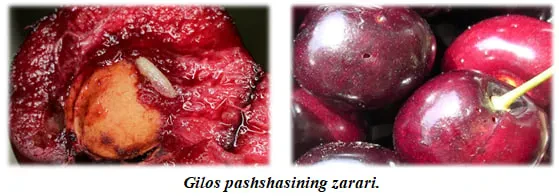
Damage: The cherry fly causes serious damage to fruit trees, mainly cherry, cherry, raspberry, mulberry, blackcurrant and red fruit shrubs. It is difficult to identify the cherry fly at first glance. Most gardeners only learn about its presence when the damage to the fruit increases and the crop is almost destroyed. Each fly causes damage by laying one egg on about 150 cherries or cherries.
Morphology: The cherry fly is a very small 5.5 mm fly, its body is bright black, its head and legs are yellow, its wings are black and white, and its eyes are light green under a microscope. The larvae mainly damage the fruits. The adult larva is 7 mm long and white.
Bioecology: In early spring, when the air temperature is +12℃ and +15℃, that is, in the second half of March, flies begin to fly from the overwintered mushrooms and feed on excrement secreted by plant juices for 12-14 days. When the air temperature is on average +18℃ and +22℃, they begin to lay eggs on young cherries and cherries. After 7-10 days, white larvae begin to hatch from the eggs. The 0.5 mm long larvae feed for 16-20 days and turn into 7 mm long adult larvae. Then they leave the damaged fruit and enter the cracks of nearby weeds and trees, pupate and go into diapause.
Use of pheromone traps: The cherry fly develops in one generation. It turns into a cocoon in June and remains in this state until the next year. When the cherry blossoms begin to bloom, the flies fly out and lay eggs on the cherry fruits. Therefore, 8-10 days before the cherry blossoms, 1 piece of cherry fly pheromone should be applied to tree branches at a height of 1.5-2 meters, and their control should be carried out until the harvest;
Agrotechnical control measures: This includes giving tree branches a phytosanitary form, plowing between rows of cherry and sour cherry trees and cultivating their surroundings to a depth of 15-20 cm, cleaning the area around the trees and between the rows from weeds, and controlling fertilization with mineral fertilizers, etc.
Biological control measures: The larvae of the common goldfinch (Chrysoperla carnea) are very predatory, eating an average of 15-20 flies per day.
Chemical control measures: In early spring, treat cherry and cherry trees with mineral oil emulsion preparations and ISO and Bordeaux liquids. After the female flies emerge from the fungus for 12-14 days, after additionally feeding on nectar and excrement secreted by sucking insects, at an average air temperature of +18℃ and +22℃, before they begin to lay eggs on young cherry and cherry fruits, organize treatment with insecto-acaricides containing the active ingredients abamectin, imidocloprid and lambda-cyhalothrin as a chemical control.